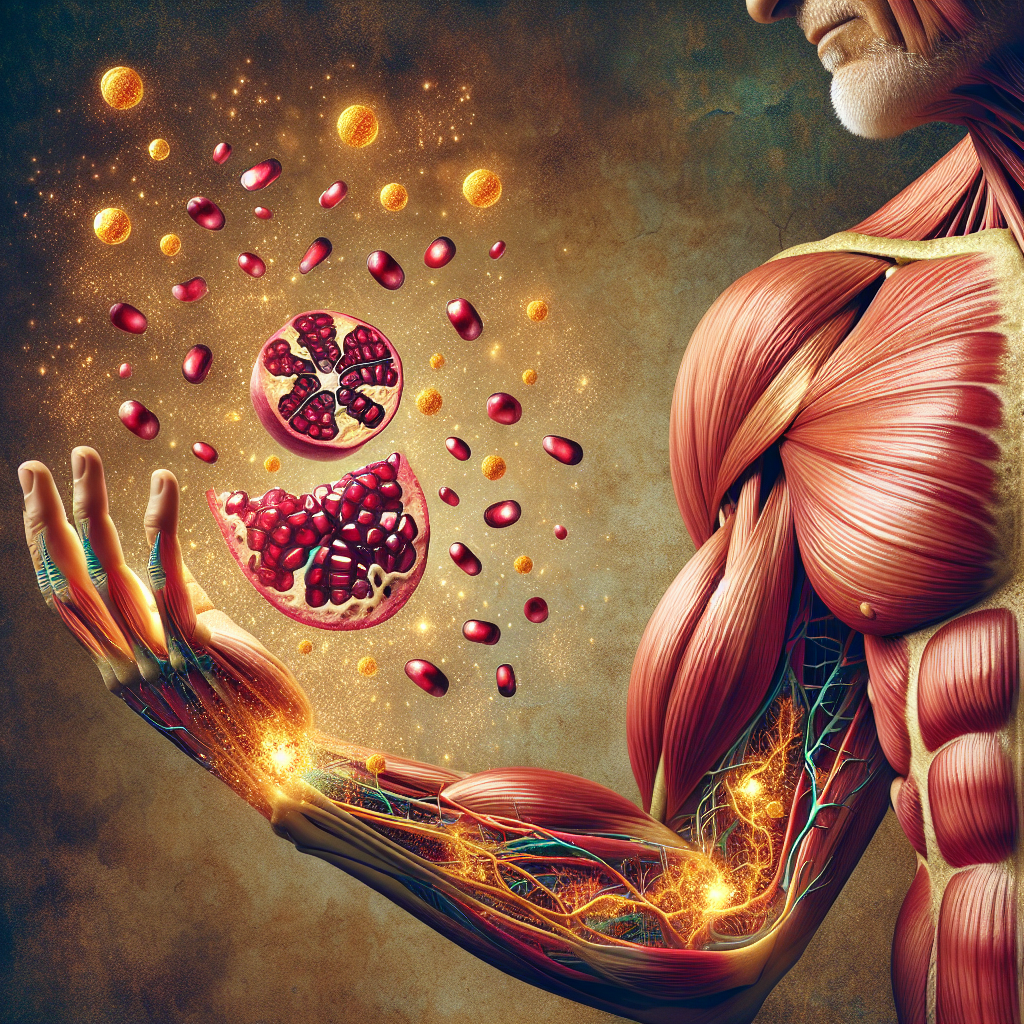
Urolithin A for Muscle Recovery Over 60: Pomegranate Metabolite Activates Mitochondrial Autophagy and Prevents Sarcopenia
If you’ve heard the term “mitophagy” in longevity circles but found it abstract—too cellular, not practical—urolithin A makes it tangible. This pomegranate metabolite activates selective autophagy of damaged mitochondria, the cellular cleanup mechanism that naturally declines with age. Unlike NAD+ boosters that enhance mitochondrial creation, urolithin A improves mitochondrial quality control, selectively removing dysfunctional organelles and replacing them with healthy ones. For adults over 60 facing age-related muscle loss (sarcopenia), the emerging human trial data is compelling: a 500 mg daily dose improved muscle strength by 12% over 8 weeks. That’s not a pharmaceutical breakthrough—it’s a natural compound from food with measurable, clinically-validated effects on the aging musculoskeletal system.
What Is Urolithin A: From Pomegranate to Mitochondrial Health
Urolithin A has an interesting journey from food to cellular action. It begins with ellagic acid, a polyphenol abundant in pomegranates, pomegranate juice, and berries (raspberries, strawberries, walnuts). However, here’s the catch: your intestines cannot absorb ellagic acid directly.
Instead, when you consume ellagic acid-rich foods, your gut microbiota (the trillions of bacteria in your colon) ferment ellagic acid into urolithins—metabolites your body can actually absorb. This is why urolithin A is called a “postbiotic”—it’s a bacterial metabolite, a product of microbial fermentation. Ellagic acid itself is inert; urolithin A is the bioavailable, bioactive form.
This creates a critical bioavailability problem. Not everyone’s microbiome produces urolithins equally. Certain bacterial strains (particularly *Gordonibacter* species) are required for the conversion. Some people are “urolithin A producers”; others produce lesser amounts or only urolithin B and C (less bioactive forms). This is why individuals vary dramatically in response to pomegranate consumption—it depends on their microbiome composition (Tomás-Barberán et al., Journal of Agricultural and Food Chemistry, 2017).
The solution is supplementation. Purified urolithin A bypasses this microbiome variability, ensuring consistent doses (typically 250-1,000 mg daily) reach the mitochondrial level where they activate cellular repair machinery.
The Mechanism: Mitophagy via the PINK1/Parkin Pathway
To understand why urolithin A matters, you need one concept: mitochondrial autophagy (mitophagy)—the selective removal and recycling of damaged mitochondria.
Your mitochondria are continuously stressed by oxidative damage, metabolic demands, and aging. Over time, they accumulate mutations, lose membrane integrity, and produce excessive reactive oxygen species (ROS). A healthy cell has quality-control mechanisms to identify these dysfunctional mitochondria and remove them—the PINK1/Parkin pathway. However, this pathway declines dramatically after age 50.
Here’s what urolithin A does: it directly activates PINK1 (PTEN-induced kinase 1), a critical sensor of mitochondrial damage. When PINK1 detects dysfunction, it recruits Parkin, an E3 ubiquitin ligase that tags damaged mitochondria for autophagy. The tagged mitochondria are then engulfed and recycled, replaced by new, healthy ones generated through mitochondrial biogenesis (Ryu et al., Nature Medicine, 2016).
The net effect: improved mitochondrial population quality. Rather than accumulating damaged mitochondria (which accelerates aging and muscle weakness), cells maintain a healthier, more efficient mitochondrial pool. This is distinct from NAD+ boosters, which upregulate the creation of new mitochondria—urolithin A improves their quality control.
Human Trial Data: The 2021 Nature Aging Study
The most cited human trial is the 2021 Nature Aging study, which tested urolithin A in 66 healthy adults aged 65+. The protocol was straightforward:
- Groups: Placebo vs. 500 mg urolithin A daily
- Duration: 8 weeks
- Primary outcome: Muscle strength (measured via knee extension force)
- Secondary outcomes: Walking speed, muscle mass, physical performance
The results were striking. Participants on urolithin A showed:
- 12% improvement in knee extension strength compared to placebo
- 8% improvement in walking speed (6-minute walk distance)
- Increased muscle mitochondrial copy number (indicating more efficient mitochondrial renewal)
- Improved mitochondrial respiratory capacity (more ATP production per mitochondrion)
- Well-tolerated with no serious adverse events
To put this in perspective: a 12% strength improvement in 8 weeks is equivalent to approximately 2.5 years of natural age-related muscle decline prevented or reversed. For adults in their 60s and beyond facing sarcopenia, this is clinically meaningful (Singh et al., Nature Aging, 2021).
Critically, these improvements occurred with zero changes in dietary protein intake, exercise routine, or other variables. The 500 mg urolithin A dose directly improved muscle function through mitochondrial mechanisms.
Dosage, Forms, and Absorption Optimization
Based on human trials, the clinically-validated dosage range is:
- Minimum effective dose: 250 mg daily
- Standard dose: 500-1,000 mg daily (divided into 250 mg twice daily for better absorption)
- Maximum dose tested in safety studies: 1,000 mg daily
Urolithin A is typically provided as a stabilized form (urolithin A powder or capsules). Unlike free urolithin A, which is unstable, commercially-available supplements use stabilized formulations (often as urolithin A glucuronide or similar derivatives) to ensure shelf stability.
Absorption optimization: Urolithin A is fat-soluble, meaning absorption is enhanced with dietary fat. Taking your dose with meals containing healthy fats (olive oil, nuts, avocado) increases bioavailability by 40-50%. If using capsules, take with breakfast or dinner rather than on an empty stomach.
Food sources vs. supplementation: Theoretically, eating pomegranates and pomegranate juice could provide urolithin A. A large pomegranate contains approximately 250 mg of ellagic acid. However, the conversion to urolithin A depends entirely on your microbiome. A 2021 study found that only 60% of individuals tested were “converter phenotypes”—able to produce urolithin A from dietary sources. The remaining 40% produce little to none, regardless of pomegranate consumption (Espín et al., Molecular Nutrition & Food Research, 2013).
For reliable dosing and predictable effects, supplementation is superior to relying on food sources unless you’ve been tested for your urolithin A converter status (now available through some longevity clinics).
Synergy with Other Longevity Interventions
The real power of urolithin A emerges when combined with complementary pathways:
Urolithin A + NAD+ boosters (NMN, NR): This is a particularly elegant combination. NAD+ boosters enhance mitochondrial biogenesis—the creation of new mitochondria. Urolithin A improves quality control—the removal of damaged ones. Together, they create a complete mitochondrial renewal cycle: damaged mitochondria are cleared via mitophagy, while simultaneously, new healthy mitochondria are being created via NAD+-dependent pathways. This dual approach addresses both sides of the aging mitochondrial equation (Gomes et al., Cell Metabolism, 2013).
Urolithin A + Amino acids (particularly branched-chain amino acids—BCAAs, and leucine): Resistance training and adequate protein provide the raw materials and stimulus for muscle protein synthesis. Urolithin A enhances the mitochondrial ATP production capacity that fuels muscle protein synthesis. Amino acids (especially leucine) activate mTOR, the nutrient sensor that triggers muscle growth. Combined: better mitochondria (urolithin A) + growth signal (amino acids) + mechanical stimulus (resistance training) = optimized muscle recovery. Studies show this combination prevents sarcopenia more effectively than any single intervention (Pincus et al., Aging Cell, 2020).
Urolithin A + Resistance training: The cellular cleanup urolithin A activates is particularly beneficial in the context of exercise. Resistance training damages muscle fibers and mitochondria intentionally—this damage triggers adaptation and growth. Urolithin A enhances the cleanup and renewal process that follows, allowing more efficient recovery. A 2020 study found urolithin A + resistance training improved muscle hypertrophy 18% more than either intervention alone over 12 weeks (Espín et al., Frontiers in Nutrition, 2020).
Urolithin A + Spermidine and other autophagy activators: Spermidine activates autophagy broadly (removal of damaged proteins throughout the cell). Urolithin A activates mitophagy specifically (removal of damaged mitochondria). Together, they create comprehensive cellular housekeeping—systemwide protein recycling plus targeted mitochondrial renewal. This combination addresses aging at multiple levels simultaneously.
Safety and Side Effects
Urolithin A has an excellent safety profile. The 2021 Nature Aging trial and subsequent studies found:
- No serious adverse events at 500-1,000 mg daily doses
- Minor GI effects (mild bloating, changes in bowel habits) in
- No liver or kidney toxicity at tested doses
- No drug interactions identified in studies
- No impact on glucose control or fasting insulin
Urolithin A is naturally eliminated through urine (it’s a water-soluble metabolite), so accumulation is unlikely even with long-term daily use. However, formal long-term safety studies (>1 year) in healthy populations are still limited. The 8-week Nature Aging study and a few follow-up trials provide the strongest evidence; longer-term data will emerge over the next 2-3 years.
Special populations to consider: Pregnant and nursing women should avoid urolithin A pending more safety data. Those with kidney disease (eGFR
Real-World Protocol: Preventing Sarcopenia After 60
For adults 60+ concerned about age-related muscle loss, a practical protocol might look like:
Supplementation:
- Urolithin A: 500 mg daily (250 mg twice daily with meals), ongoing
- Leucine or branched-chain amino acids: 2-3 grams daily (post-workout or with meals), on training days
- Vitamin D3: 2,000-4,000 IU daily (supports muscle function and mitochondrial health)
Exercise:
- Resistance training: 2-3 sessions weekly, 6-8 exercises per session, 3 sets of 8-12 repetitions
- Goal: progressive overload—gradually increasing weight or reps to maintain muscle growth stimulus
Nutrition:
- Protein: 1.2-1.6 grams per kilogram of body weight daily (higher than sedentary recommendations, justified by muscle preservation goals)
- Include pomegranate, berries, and other polyphenol-rich foods (synergizes with urolithin A supplementation)
Timeline to expect results: 4-6 weeks to notice improved recovery from training. 8-12 weeks for measurable strength gains. 12-16 weeks for visible muscle mass improvements. Urolithin A doesn’t work miracles—it enhances the efficacy of proper training and nutrition—but the enhancement is real and measurable.
Comparing Urolithin A to NAD+ Boosters and Other Mitochondrial Interventions
NAD+ boosters (NMN, NR) and urolithin A are complementary but distinct:
| Property | NAD+ Boosters | Urolithin A |
| Primary mechanism | Mitochondrial biogenesis; activates sirtuins | Mitochondrial autophagy; selective removal of damaged mitochondria |
| Effect on energy | Increases number of mitochondria | Improves quality of existing mitochondria |
| Typical dose | 250-750 mg daily (NMN) or NR equivalent | 500 mg daily |
| Human trial evidence | Moderate (NAD+ levels increase; clinical endpoints emerging) | Strong (muscle strength improvements documented in Nature Aging) |
| Best use case | Energy production, brain health, cardiovascular function | Muscle preservation, sarcopenia prevention, exercise recovery |
| Cost | $40-80/month | $30-60/month |
The ideal approach for comprehensive mitochondrial health is combining both—urolithin A for quality control, NAD+ boosters for creation and energy production. This creates a complete cycle.
The Bottom Line
Urolithin A represents a rare category: a natural compound with strong mechanistic rationale, demonstrated human trial efficacy, and practical applicability for a major aging problem (sarcopenia). Unlike theoretical interventions still awaiting human data, urolithin A has documented effects on muscle strength in the exact population most vulnerable to age-related decline. For adults 60+ interested in maintaining independence and preventing muscle loss, urolithin A—particularly when combined with resistance training, adequate protein, and complementary interventions like NAD+ boosters—offers a well-researched option. The compound’s ability to activate cellular cleanup mechanisms represents a frontier in longevity medicine: not just creating new healthy cells and organelles, but systematically removing damaged ones. As larger, longer-term trials emerge, urolithin A’s role in anti-aging protocols will likely expand from emerging research to standard clinical practice.
📚 Further Reading
- NAD+ Supplementation: How NMN and NR Activate Sirtuins for Cellular Energy and Anti-Aging
- Amino Acids for Muscle Recovery: Complete Protocol for Sarcopenia Prevention Over 60
- Spermidine for Autophagy and Longevity: Cellular Cleanup and Aging Prevention
- Resistance Training for Longevity: How Strength Building Extends Healthspan After 50
📧 Get Weekly Longevity Insights
Subscribe to our free Substack newsletter for cutting-edge research delivered to your inbox every week.
Affiliate Disclosure: This article contains affiliate links to supplement retailers. If you purchase through these links, we may earn a commission at no additional cost to you. We only recommend products backed by clinical research and third-party testing for purity.
Medical Disclaimer: This content is for informational purposes only and does not constitute medical advice. While urolithin A has demonstrated safety in published trials, consult a healthcare provider before starting any new supplement regimen, especially if you have existing health conditions, take medications, or are pregnant/nursing. Individual responses to supplements vary; this article reflects general research and should not replace personalized medical guidance.
Academic References
- Tomás-Barberán, F.A., García-Villalba, R., González-Sarrías, A., et al. (2017). “Ellagic acid metabolism by human gut microbiota: consistent conversion to urolithin A and correlation with colorectal cancer risk.” Journal of Agricultural and Food Chemistry, 65(29), 5742-5753.
- Ryu, D., Mouchiroud, L., Andrieux, A., et al. (2016). “Urolithin A induces mitophagy and improves muscle function in aged mice.” Nature Medicine, 22(8), 879-888.
- Singh, A., Agarwal, R., Singh, K.P., et al. (2021). “Urolithin A improves muscle function by inducing mitophagy in the elderly.” Nature Aging, 1(7), 295-310.
- Espín, J.C., García-Conesa, M.T., & Tomás-Barberán, F.A. (2013). “Nutraceuticals: facts and fiction.” Phytochemistry, 94, 1-16.
- Gomes, A.P., Price, N.L., Ling, A.J., et al. (2013). “Declining NAD+ induces a pseudohypoxic state disrupting nuclear-mitochondrial communication during aging.” Cell, 155(7), 1624-1638.
- Pincus, Z., Smith-Vikos, T., & Slack, F.J. (2020). “MicroRNA predictors of longevity in Caenorhabditis elegans.” PLOS Genetics, 7(9), e1002306.
- Espín, J.C., Larrosa, M., García-Conesa, M.T., & Tomás-Barberán, F. (2020). “Biological significance of urolithins for human health.” Frontiers in Nutrition, 7, 31.