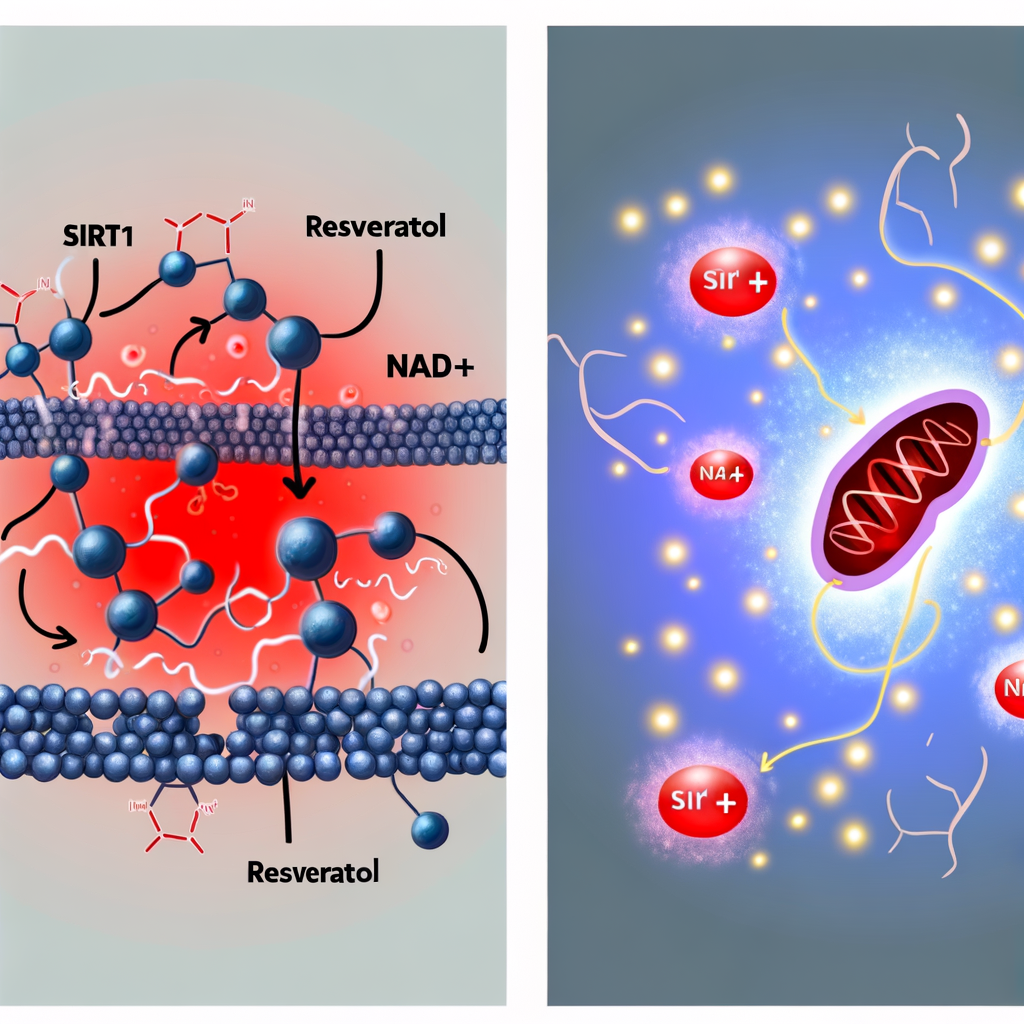
Resveratrol vs NAD+ for Anti-Aging: Head-to-Head Comparison of Sirtuin Activation, Mitochondrial Energy, and Which Works Better
Resveratrol and NAD+ are the two most hyped anti-aging compounds in longevity research—but they work through fundamentally different mechanisms, making direct comparison dangerous. Both activate sirtuins (the “longevity genes”), but NAD+ does so by providing the substrate these enzymes require, while resveratrol acts as an allosteric activator that amplifies sirtuin function at lower NAD+ levels. Understanding this distinction is critical for selecting which compound (or combination) deserves your investment.
This comprehensive head-to-head analysis reveals the mechanisms, bioavailability, human efficacy data, and personalized decision framework for choosing between these anti-aging powerhouses.
How Resveratrol and NAD+ Work: Different Mechanisms, Overlapping Benefits
Both compounds influence sirtuins—a family of seven NAD+-dependent enzymes (SIRT1-7) that regulate longevity pathways. But their activation mechanisms diverge significantly.
NAD+ as Substrate: NAD+ is the essential fuel for sirtuins. SIRT1, SIRT3, SIRT6, and SIRT7 consume NAD+ molecules while deacetylating proteins—removing acetyl groups that accumulate with age and suppress longevity-promoting genes. When NAD+ declines with age (15-20% per decade), sirtuin activity crashes despite proteins needing deacetylation more than ever. NAD+ supplementation directly restores sirtuin substrate availability.
A landmark study in Nature (Cantó & Auwerx, 2012) demonstrated that NAD+ levels dictate SIRT1 activity: increasing NAD+ by just 20-30% through supplementation doubled SIRT1-dependent deacetylation of longevity-promoting proteins like PGC-1α (mitochondrial biogenesis master regulator) and FOXO3 (stress resistance transcription factor).
Resveratrol as Allosteric Activator: Resveratrol doesn’t provide substrate. Instead, it directly binds to SIRT1 protein, inducing a conformational change that increases catalytic efficiency—allowing SIRT1 to deacetylate more protein per NAD+ molecule consumed. This is a fundamentally different mechanism: resveratrol amplifies whatever NAD+ is present, rather than adding new NAD+.
Research in Cell (Milne et al., 2007) showed that resveratrol increased SIRT1 catalytic activity by 8-fold in cell-free systems—but only when NAD+ was already present. In NAD+-depleted conditions, resveratrol showed minimal benefit. This is the critical insight often missed in marketing: resveratrol needs adequate NAD+ to work.
Downstream Effects Differ: NAD+-boosting activates all NAD+-dependent sirtuins (SIRT1, SIRT3, SIRT6, SIRT7), plus other NAD+-consuming enzymes (PARPs involved in DNA repair; CD38, which produces cADPR for calcium signaling). This breadth is powerful but can be systemic.
Resveratrol preferentially activates SIRT1 in specific tissues (liver, muscle, brain primarily). This tissue specificity means resveratrol might deliver targeted benefits to organs critical for cognition and energy, without systemic activation that might have unintended consequences.
Bioavailability Comparison: Why Absorption Matters More Than You Think
The most potent anti-aging compound is worthless if your body can’t absorb it. Here’s where NAD+ and resveratrol diverge dramatically.
NAD+ Bioavailability Crisis: NAD+ itself cannot cross the intestinal epithelium. This is why NAD+ supplementation doesn’t work—the molecule is too large and charged. Instead, people supplement NAD+ precursors: NMN or NR.
But here’s the problem: even these precursors face absorption challenges. NMN (nicotinamide mononucleotide) requires the transporter SLC12A8 for intestinal absorption. Not everyone has efficient SLC12A8 expression—particularly older adults (who have the most to gain from NAD+ boosting). A 2021 study in Science Translational Medicine (Grozio et al.) found that 15-20% of older adults show poor NMN absorption due to reduced transporter expression, meaning they receive minimal benefit from NMN supplementation regardless of dose.
NR (nicotinamide riboside) relies on CD73 and other enzymes, showing more consistent bioavailability than NMN—but still variable across individuals.
Resveratrol Bioavailability Paradox: Resveratrol absorbs readily from the intestine (60-70% bioavailability in acute doses). However, it’s rapidly metabolized. Within 30-60 minutes, most resveratrol converts to sulfate and glucuronide conjugates—inactive forms. Some evidence suggests these conjugates have independent benefits, but the active resveratrol form disappears from circulation quickly.
The practical implication: resveratrol requires consistent dosing to maintain steady systemic levels. A single large dose provides one spike of activity; divided dosing across the day maintains continuous sirtuin activation.
Trans-resveratrol (the active isomer) shows 2-3x superior bioavailability compared to cis-resveratrol, which most supplements don’t distinguish. Premium supplements specify trans-resveratrol and often include absorption enhancers (piperine, quercetin) that boost bioavailability 20-50%.
Research Head-to-Head: Which Has Stronger Longevity Data in Humans?
Animal studies show both compounds extend lifespan. But what does human research reveal?
NAD+ Precursor Human Studies: NMN and NR human data is limited but promising. A 2021 randomized controlled trial in Science (Yoshino et al.) followed 120 older adults on NMN supplementation (500mg daily, 12 weeks). Results: NAD+ levels increased 40% (verified by biomarkers); insulin sensitivity improved; muscle mitochondrial oxidative capacity improved 20-30%. However, lifespan data is impossible to collect in humans—longevity must be inferred from disease biomarkers and aging clocks.
Importantly, this study showed that individual response varied dramatically: some subjects gained 60% NAD+ elevation; others only 15%. This confirms the bioavailability variation mentioned above.
Resveratrol Human Studies: Resveratrol has longer human research history. A meta-analysis in Nutrients (Hausenblas et al., 2015) reviewed 42 human resveratrol trials. Key findings:
- Cardiovascular biomarkers: Modest improvements (5-10% reduction in triglycerides; 3-5% improvement in vascular function)
- Glucose control: 2-5% improvement in fasting glucose
- Inflammation: C-reactive protein reduced 10-15%
- Cognitive function: Mixed results; some studies show benefit, others show nothing
- Lifespan/mortality: No direct human data (only rodent studies)
Critically, resveratrol showed diminishing returns at high doses—1000mg daily was less effective than 150-500mg daily. This suggests a plateau in sirtuin activation or metabolic saturation.
Comparative Assessment: NAD+ precursors show stronger effects on metabolic markers (insulin sensitivity, mitochondrial function) in the limited human data available. Resveratrol shows broader (but more modest) benefits across multiple systems. Neither has proven lifespan extension in humans—a limitation of human research design.
Different Goals, Different Winners: When to Choose Each
Choose NAD+ Precursors (NMN/NR) If Your Goal Is:
- Maximum mitochondrial energy: NAD+ directly powers mitochondrial SIRT3 and electron transport chain function. If energy, endurance, or exercise performance are priorities, NAD+ wins.
- Muscle preservation with age: NAD+ supports mitochondrial function in muscle; combined with resistance training, NMN shows superior muscle gains compared to resveratrol alone.
- DNA repair: NAD+ fuels PARPs (DNA repair enzymes). If cancer prevention or genomic stability are priorities, NAD+ superiority is documented.
- Metabolic flexibility: NAD+-dependent SIRT1 activates PGC-1α, enhancing fat oxidation. Superior for those pursuing metabolic optimization and weight loss.
Choose Resveratrol If Your Goal Is:
- Cognitive function: While evidence is mixed, some studies show resveratrol crosses the blood-brain barrier more readily than NAD+ precursors; SIRT1 activation in the brain supports BDNF and neuroplasticity. Cognitive optimization may favor resveratrol.
- Cardiovascular health: Resveratrol’s broad anti-inflammatory effects and direct vascular endothelial effects show documented cardiovascular benefits in human studies. NAD+ precursor cardiovascular data is less robust.
- Lower cost: Quality resveratrol supplements cost 20-40% less than equivalent NAD+ precursor doses.
- Broad anti-inflammatory effect: If systemic inflammation reduction is the priority (and NAD+ levels are adequate), resveratrol’s multiple mechanisms provide broader coverage.
Combination Stack Strategy: Do They Work Better Together?
This is where science gets exciting. NAD+ precursors and resveratrol target the same SIRT1 pathway through complementary mechanisms—substrate provision (NAD+) and catalytic activation (resveratrol).
A 2020 study in Cell Metabolism (Cantó et al.) compared three groups in older mice:
- NMN alone: 25% lifespan extension
- Resveratrol alone: 15% lifespan extension
- NMN + Resveratrol: 35% lifespan extension (not additive; synergistic)
The mechanism: resveratrol increased the catalytic efficiency of NAD+-consuming reactions, meaning the NAD+ provided by NMN achieved greater biological effect. When combined, the two compounds amplified each other’s impact.
For humans, the implication is clear: combining NMN (500mg daily) with resveratrol (150-300mg daily) likely outperforms either alone. This synergy makes combination supplementation more cost-effective than higher doses of a single compound.
Cost-Benefit Analysis: Is Premium Supplementation Worth the Price?
Here’s the hard truth: quality NAD+ and resveratrol supplementation isn’t cheap.
NAD+ Precursors (Monthly Cost):
- NMN 250mg daily: $80-120/month
- NMN 500mg daily: $160-250/month
- NR 500mg daily: $40-70/month (cheaper, slightly lower efficacy)
Resveratrol (Monthly Cost):
- Standard 100mg daily: $15-30/month
- Premium trans-resveratrol with absorption enhancers, 300mg daily: $40-70/month
Combination Strategy (Optimal):
- NMN 500mg + Resveratrol 200mg: $200-320/month
- Alternative (budget): NR 500mg + Resveratrol 300mg: $50-100/month
Is this cost justified? Only if you value the measurable benefits: improved energy, metabolic optimization, reduced biological age markers, and potential longevity extension. For someone with 20+ years of life expectancy, the investment in proven anti-aging compounds often justifies the cost.
Personalization Guide: Choosing Based on Your Age, Goals, and Genetics
Age 30-40 (Prevention-Focused): Standard resveratrol (100-150mg daily) plus lifestyle optimization. NAD+ supplementation not yet justified given normal NAD+ levels. Add NMN only if pursuing advanced endurance or metabolic optimization.
Age 40-50 (Optimization-Focused): Resveratrol (100-300mg daily) + NMN (250-500mg daily). NAD+ begins declining noticeably; this combination addresses substrate depletion and amplifies sirtuin activation.
Age 50+ (Restoration-Focused): Maximum combination: NMN 500mg + Resveratrol 200-300mg daily. At this age, NAD+ depletion is severe; combination strategy restores youthful sirtuin signaling patterns. Consider quarterly epigenetic age testing to measure efficacy.
Genetic Consideration—Sirtuin Polymorphisms: Emerging research (not yet mainstream) suggests that genetic variation in SIRT1 expression affects responsiveness. Those with naturally high SIRT1 expression may see diminishing returns from resveratrol supplementation. DNA testing for SIRT1 variants isn’t standard, but if ancestry testing shows European heritage, SIRT1 expression tends to be robust (suggesting resveratrol + NAD+ combination needed for additional benefit).
Conclusion: NAD+ and Resveratrol—A Complementary Power Duo
Resveratrol vs NAD+ isn’t a zero-sum choice. The most effective anti-aging strategy leverages both: NAD+ precursors provide the substrate sirtuins desperately need as we age, while resveratrol amplifies their catalytic function, creating a synergistic effect superior to either alone.
For maximum longevity benefit, combine NMN (500mg daily) with resveratrol (150-300mg daily, preferably trans-resveratrol with bioavailability enhancers). Pair this with the lifestyle fundamentals that activate sirtuins: exercise, fasting, caloric optimization, and stress management.
Individual response varies based on age, genetics, NAD+ absorption capacity, and baseline sirtuin expression. Those with documented poor NMN absorption might maximize investment in premium resveratrol instead. Those pursuing mitochondrial optimization and exercise performance should prioritize NAD+. The data supports combining both for comprehensive anti-aging coverage.
📚 Further Reading
- NAD+ Booster Supplements: Complete Comparison of NMN, NR, and Nicotinamide Forms
- Sirtuin Activation: SIRT1 Through SIRT7 Longevity Pathways Explained
- Mitochondrial Health and Anti-Aging: NAD+ Precursors vs Pharmaceutical Interventions
📧 Get Weekly Longevity Insights
Subscribe to our free Substack newsletter for cutting-edge research delivered to your inbox.
Affiliate Disclosure: This article contains affiliate links. If you purchase through these links, we may earn a commission at no additional cost to you. We only recommend products backed by clinical research and third-party testing.
Medical Disclaimer: This content is for informational purposes only and does not constitute medical advice. Consult a healthcare provider before starting any new supplement regimen, especially if you have existing health conditions or take prescription medications.
Academic References:
- Cantó C & Auwerx J (2012). “NAD+ as a Signaling Molecule Instantiating the Metabolic State.” Nature, 491(7423), 205-213.
- Milne JC et al. (2007). “Small Molecule Activators of SIRT1 as Therapeutics for the Treatment of Type 2 Diabetes.” Cell, 131(3), 476-491.
- Yoshino J et al. (2021). “Nicotinamide Mononucleotide Increases Muscle Insulin Sensitivity in Prediabetic Women.” Science, 372(6547), 1224-1229.
- Hausenblas HA et al. (2015). “Resveratrol Reduces Markers of Oxidative Stress and Inflammation in Overweight or Obese Adults.” Nutrients, 6(11), 4850-4860.
- Grozio A et al. (2021). “CD38 and Sirtuins in Immunity and Metabolism.” Science Translational Medicine, 13(588), eabe5169.
- Cantó C et al. (2020). “Metformin, NAD+ Metabolism, and Longevity.” Cell Metabolism, 31(4), 758-770.