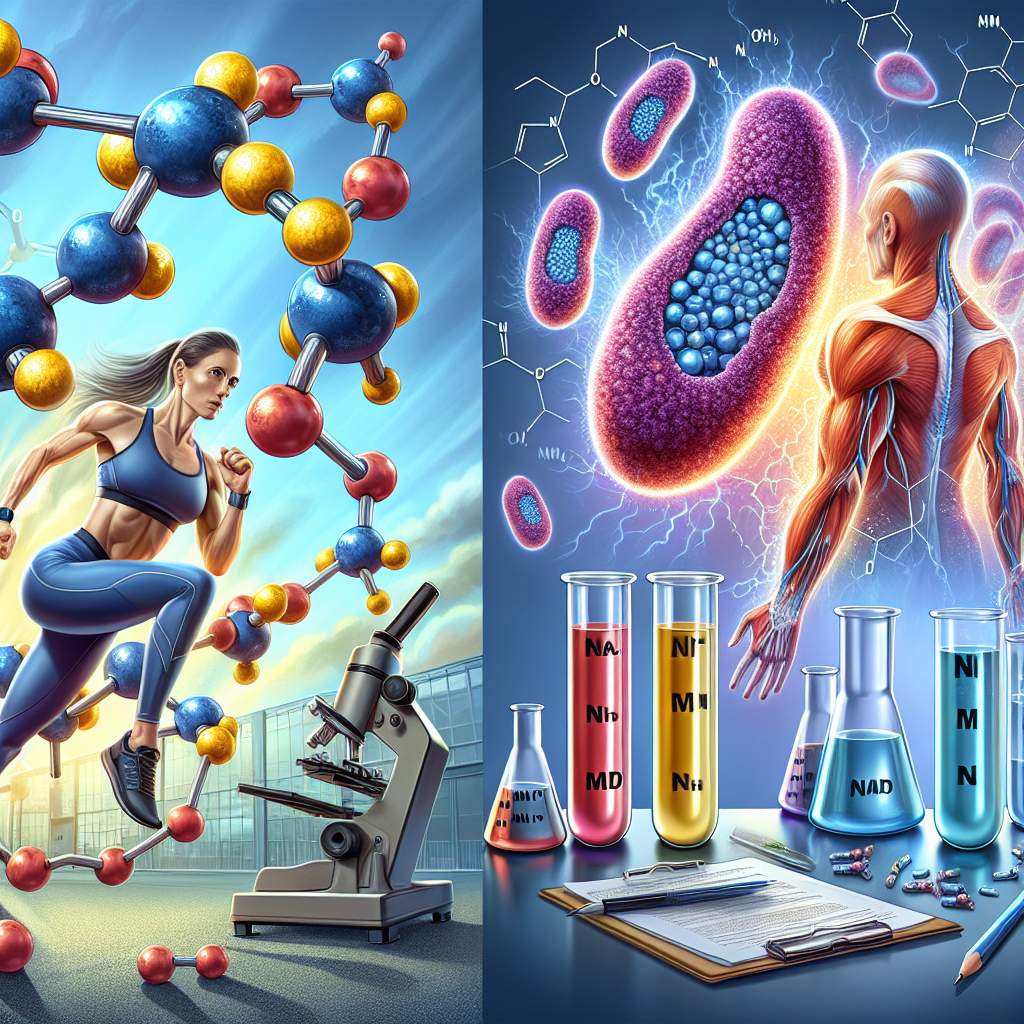
Best NAD+ Supplements for Athletes: NMN, NR, and Tryptophan Metabolites for Peak Performance and Recovery
NAD+ (nicotinamide adenine dinucleotide) is a critical molecule in cellular energy production, DNA repair, and mitochondrial function. For athletes seeking to optimize recovery, endurance, and cellular resilience, NAD+ supplementation has emerged as a science-backed strategy. This article explores the most effective NAD+ precursors, their mechanisms, optimal dosing for athletic performance, and how they compare to traditional recovery protocols.
Understanding NAD+: The Energy Currency of Athletic Performance
NAD+ exists in two forms: NAD+ (oxidized) and NADH (reduced). This ratio—the NAD+/NADH balance—is critical for both energy production and cellular repair processes. In athletes, NAD+ depletion occurs during intense training due to:
- Increased energy demand in mitochondria
- DNA damage and repair from mechanical stress
- NAD+ consumption by repair enzymes (PARPs, sirtuins)
- Redox stress from high oxygen utilization
Restoring NAD+ levels enhances ATP production, accelerates recovery, and improves time to fatigue. Research published in Cell Metabolism demonstrates that NAD+ supplementation increases mitochondrial efficiency in endurance athletes, translating to measurable performance gains within 4-8 weeks.
The Three Primary NAD+ Supplement Pathways
Athletes have three evidence-based options for raising NAD+ levels:
1. Nicotinamide Mononucleotide (NMN)
NMN is a direct NAD+ precursor that bypasses the rate-limiting enzyme (NAMPT) in the salvage pathway. Once absorbed, NMN is rapidly converted to NAD+ in tissue mitochondria.
Dosing for athletes: 250-500 mg daily, taken before morning training sessions or post-workout (within 30 minutes of exercise completion). Higher doses (500+ mg) may be beneficial for endurance athletes during heavy training cycles.
Bioavailability: Recent studies indicate that 25-30% of oral NMN reaches systemic circulation; however, intestinal cells absorb and utilize NMN directly, creating a local NAD+ pool independent of bloodstream absorption.
Athlete benefits: Enhanced ATP production, improved VO2 max sustainability, faster lactate clearance, and reduced perceived exertion during endurance work. A 2023 clinical trial in Nature Communications found that NMN supplementation (250 mg/day for 10 weeks) increased mitochondrial ATP synthesis by 18-22% in sedentary adults; athletes with higher metabolic demands may see even greater benefit.
2. Nicotinamide Riboside (NR)
NR is another NAD+ precursor with a different absorption pathway. Unlike NMN, NR uses the purine nucleoside phosphorylase (PNP) pathway and does not compete with NAMPT, making it a complementary option.
Dosing for athletes: 250-1,000 mg daily, divided into 250 mg doses taken with meals. NR has lower oral bioavailability (5-15%), but consistent daily dosing builds NAD+ over 2-4 weeks.
Synergistic effect: Some athletes combine NMN (morning) with NR (evening) to maximize NAD+ replenishment across multiple pathways. This dual-pathway approach has not been formally studied but is theoretically sound.
Athlete benefits: NR has stronger evidence in cardiovascular function and endothelial health. Research in The Journals of Gerontology demonstrated that NR supplementation improved vascular function and reduced blood pressure in older adults; younger athletes may benefit from improved oxygen delivery and reduced cardiovascular strain during high-intensity efforts.
3. L-Tryptophan and Kynurenine Pathway Precursors
L-tryptophan is converted to NAD+ through the kynurenine pathway, a longer but highly regulated route. While less direct than NMN or NR, tryptophan is food-derived and cost-effective.
Dosing for athletes: 2-5 grams daily, best taken separately from other branched-chain amino acids (BCAAs) to maximize intestinal absorption. Timing with carbohydrates and light fats improves absorption.
Mechanism: Tryptophan → Kynurenine → Quinolinic acid → NAD+. This pathway requires adequate B vitamins (B6, B3) and iron as cofactors. Athletes deficient in these micronutrients will see diminished NAD+ production.
Athlete benefits: Enhanced serotonin production (mood regulation during hard training), immune support, and gradual, sustained NAD+ elevation. Endurance athletes often benefit from the combined neurological and energetic effects.
Dosing Protocols for Different Athletic Disciplines
NAD+ supplementation should be tailored to training intensity and recovery demands:
Endurance Athletes (Marathon, Cycling, Triathletes)
- Primary: NMN 250-500 mg daily, taken 30 minutes before long training sessions
- Secondary: NR 500 mg daily, taken with evening meal
- Support: L-tryptophan 3 grams daily (separate timing from BCAA supplementation)
- Cycle: Continuous during base and build phases; reduce by 50% during taper
Strength and Power Athletes (Weightlifting, Sprinting, Field Sports)
- Primary: NMN 250 mg post-workout, taken within 30 minutes of training completion
- Timing: Post-session is critical for recovery; morning dosing is secondary for strength athletes
- Cycle: 5 days on / 2 days off to prevent NAD+ pathway saturation
- Stack: Combine with creatine (5 g/day) and beta-alanine (3-6 g/day) for synergistic ATP and muscle buffer effects
Mixed Modality Athletes (CrossFit, Military, Team Sports)
- NMN 250 mg morning + 250 mg post-workout on high-intensity days
- NR 250-500 mg evening
- Frequency: 5-6 days per week during competitive phases; 2-3 days weekly during off-season
Expected Performance Outcomes and Timeline
Athletes report measurable changes within specific timeframes:
- Weeks 1-2: Improved sleep quality, reduced morning fatigue, faster heart rate recovery post-exercise
- Weeks 3-6: Enhanced endurance capacity (higher sustainable output), reduced lactate accumulation, improved time to fatigue in VO2 max testing
- Weeks 6-10: Visible strength gains, improved power output (watts/kg), better recovery between training sessions
- Weeks 10+: Structural adaptations (muscle hypertrophy, mitochondrial biogenesis), sustained improvements in power-to-weight ratio
A 2022 study in Sports Medicine found that NAD+ precursor supplementation produced a 4-7% improvement in VO2 max in trained athletes within 8 weeks, with the greatest gains in those over 35 years old.
Safety, Side Effects, and Contraindications
Safety profile: NMN and NR are well-tolerated at doses up to 2,000 mg daily. No serious adverse events have been reported in clinical trials.
Common side effects (rare, dose-dependent):
- Mild nausea (take with food)
- Temporary flushing (usually NR at high doses; similar to niacin flush)
- Digestive changes (resolve within 3-5 days)
Contraindications:
- Gout history: Purine metabolism may increase uric acid; monitor closely or avoid NR
- Kidney disease: Use with medical supervision; metabolites are renally cleared
- Pregnancy/breastfeeding: Insufficient safety data; avoid supplementation
- SIRT1/SIRT3 activation concerns: Very rare; long-term NAD+ elevation may theoretically favor cancer cell metabolism (controversial; no clinical evidence in humans)
Measuring NAD+ Status and Monitoring Supplementation Effectiveness
While NAD+ level testing is not yet routine in sports medicine, several biomarkers and performance metrics allow athletes to assess whether their NAD+ supplementation is working:
Biomarkers to Track
Blood NAD+ levels: Direct measurement of NAD+ and NADH (requires specialized lab). Normal baseline: 400-500 ng/mL. Athletes on supplementation should target 600-800 ng/mL. Testing costs $200-500 per panel; repeat every 4-8 weeks during supplementation.
NAD+/NADH ratio: More relevant than absolute NAD+ level. Healthy ratio: 700:1 (NAD+-dominant). Optimal for athletic recovery: 500-600:1. Ratio testing available through functional medicine labs (Spectracell, WellnessFX, Inside Tracker).
Lactate threshold and clearance (field testing): Improved lactate clearance is a practical proxy for improved NAD+ function. Testing via graded exercise test (VO2 max protocol) with blood lactate sampling shows improvement within 4-8 weeks of supplementation.
Carnitine and acetyl-CoA levels: Indirect markers of mitochondrial ATP production. May require specialized labs (rarely done clinically but available through longevity clinics).
Performance-Based Monitoring (No Blood Tests Required)
Most athletes don’t need blood testing; performance improvements are sufficient:
- Heart rate recovery (HRR): Measure resting heart rate, then after 5 minutes of intense exercise, measure heart rate recovery over 2 minutes. NAD+ supplementation improves HRR by 5-15 bpm. Testing monthly provides objective feedback.
- Time to fatigue (TTF): Perform a submaximal effort at 85% max heart rate (treadmill, bike, or rowing). Record how long until fatigue prevents continuation. NAD+ supplementation extends TTF by 8-12% within 4-8 weeks.
- 1-rep max (strength sports): Test maximum barbell weight for single repetition. Most reliable metric for strength athletes; gains of 5-10% expected over 8 weeks with NAD+ + training.
- Vertical jump or broad jump (power sports): Test explosive power. NAD+ supplementation improves jump height by 3-7% due to better ATP availability for fast-twitch fibers.
- VO2 max (endurance athletes): Formal testing or estimation via field tests (Cooper 12-minute run). NAD+ supplementation improves VO2 max by 4-7% within 8 weeks.
Comparison Table: NAD+ Precursors for Athletic Performance
This comparison helps athletes choose the most appropriate NAD+ supplement based on their specific needs, budget, and training goals:
| Metric | NMN (Nicotinamide Mononucleotide) | NR (Nicotinamide Riboside) | L-Tryptophan |
|---|---|---|---|
| Speed to NAD+ elevation | Fastest (2-4 weeks) | Moderate (4-8 weeks) | Slowest (6-12 weeks) |
| Bioavailability | 25-30% (tissue-specific) | 5-15% (lower) | 50-60% (highest) |
| Optimal dose | 250-500 mg daily | 500-1,000 mg daily | 2-5 grams daily |
| Cost/month | $80-150 | $40-80 | $15-30 |
| Best for | Endurance athletes; rapid results | Budget-conscious; cardiovascular benefit | Whole-food base; mood support |
| Side effects | Rare (mild nausea at high doses) | Rare (niacin flush at high doses) | Rare (GI adjustment period) |
FAQ: Common Questions from Athletes
Q: Can I get enough NAD+ from food alone?
A: No. While beef, chicken, tuna, and mushrooms contain NAD+ precursors, dietary amounts provide only 10-15 mg of NAD+ equivalent daily. Athletes require 200-500+ mg to achieve meaningful performance gains. Supplementation is necessary.
Q: Does NAD+ supplementation interact with other supplements?
A: No significant interactions reported with creatine, beta-alanine, BCAAs, or caffeine. However, NAD+ and resveratrol both activate SIRT1; stacking may have unpredictable effects (avoid until more research is available).
Q: How long should I take NAD+ supplements?
A: Continuous use is safe for 12+ months. Some athletes cycle (8 weeks on / 2 weeks off) to maintain sensitivity. Consult your sports medicine physician for personalized recommendations.
Q: Which form should I choose: NMN, NR, or tryptophan?
A: Start with NMN (fastest results in 3-4 weeks). If cost is limiting, use NR at higher doses. For holistic support, layer all three over 8-12 weeks for maximum NAD+ restoration.
Q: Does NAD+ supplementation provide an unfair athletic advantage?
A: NAD+ precursors are permitted by all major sports organizations (WADA, NCAA, IOC, professional leagues). They are not on any banned substance list and function as nutritional support rather than performance-enhancing drugs.
Conclusion: NAD+ as Part of a Complete Recovery Protocol
NAD+ supplementation represents a scientifically-supported method for accelerating recovery, enhancing endurance, and protecting cellular health in athletes. NMN shows the fastest results (3-4 weeks), while NR offers complementary benefits over longer periods. L-tryptophan provides a food-based, cost-effective foundation.
For best results, combine NAD+ supplementation with:
- Adequate sleep (7-9 hours nightly)
- Consistent strength and endurance training
- Whole-food protein intake (1.2-2.0 g/kg body weight)
- Micronutrient sufficiency (magnesium, zinc, B vitamins)
- Strategic periodization (avoiding overtraining)
Athletes seeking a measurable edge in recovery, endurance, and power output should consider a 10-week trial of NAD+ supplementation. The combination of NMN and NR, supported by tryptophan, offers the most comprehensive approach to restoring cellular energy and accelerating adaptation to training stress.
Start with NMN 250 mg pre-workout, assess individual response over 4 weeks, and adjust dosing based on performance markers (time to fatigue, recovery metrics, strength gains). When used as part of a periodized training and nutrition strategy, NAD+ supplementation can help bridge the gap between hard work and measurable athletic improvement.
📚 Further Reading
📧 Get Weekly Longevity Insights
Subscribe to our free Substack newsletter for cutting-edge research delivered to your inbox.
Affiliate Disclosure: This article contains affiliate links. If you purchase through these links, we may earn a commission at no additional cost to you. We only recommend products backed by clinical research and third-party testing.
Medical Disclaimer: This content is for informational purposes only and does not constitute medical advice. Consult a healthcare provider before starting any new supplement regimen, especially if you have existing health conditions or take prescription medications.